The first element AI needs is context
AI is now central to how enterprises compete, but AI is only as capable as its business context. First Element delivers that context, creating a single, unified context layer to power every AI tool, pipeline, and person.

Enterprise knowledge is tribal, not institutional
The greatest barrier to enterprise AI isn't the technology. It's the fact that critical business knowledge remains scattered and inaccessible across people, documents, data, and code.
Context-as-a-Service
A single, trusted repository that captures the multi-dimensional context of every business concept, entity, and data element, delivering it as a service to AI agents, chatbots, and humans across the enterprise.
Context Enrichment Pipeline
The Definitive Enterprise Context Graph
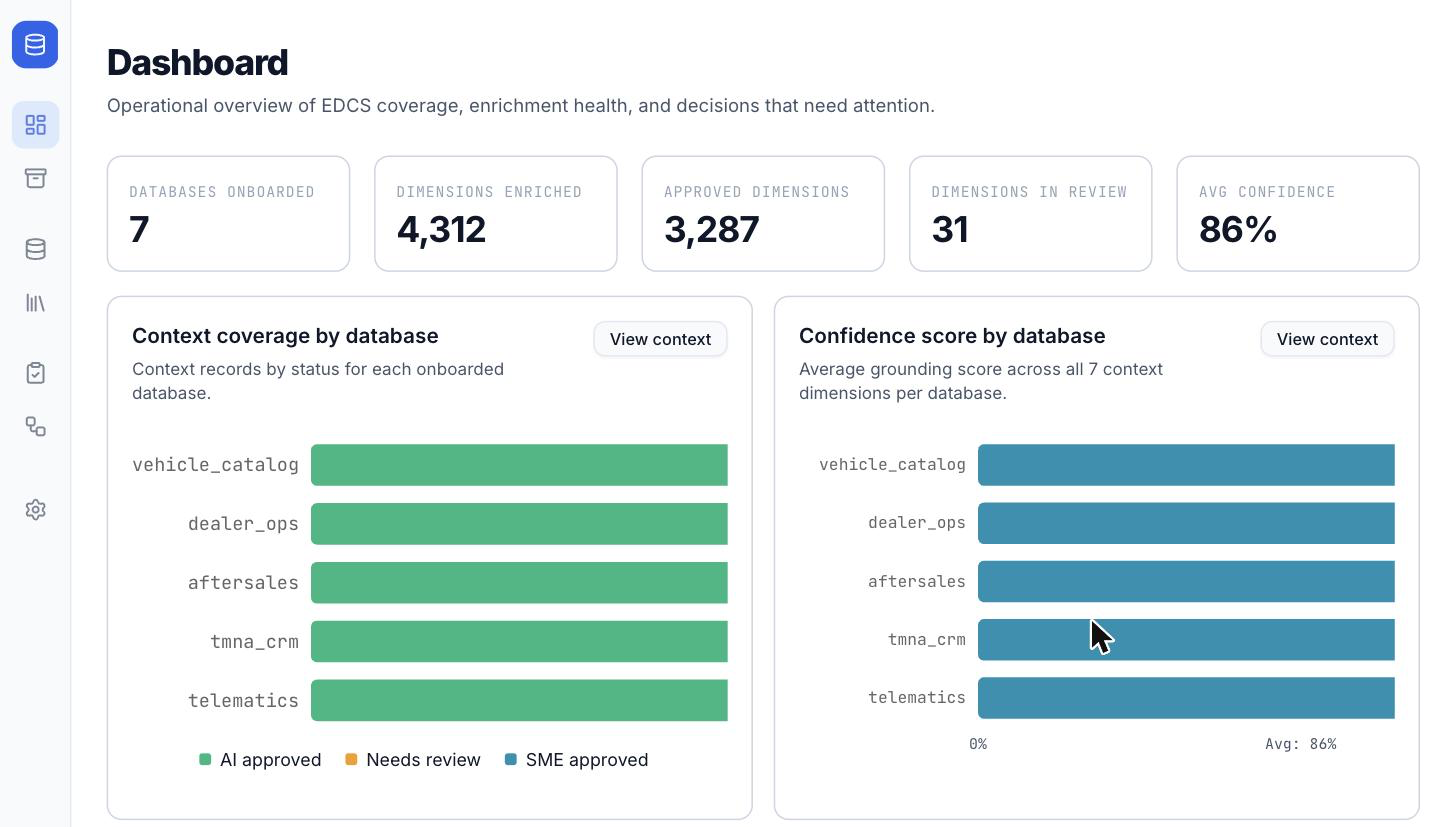
Every concept and data element continuously enriched, confidence-scored, and ready to power your AI agents.
How We Compare
Existing data catalogs, knowledge tools, and ontologies capture only fragments of your business context. Aura solves it across every dimension, delivering a complete, fully portable intelligence layer with zero vendor lock-in.
Data catalogs excel at inventory and lineage, but bolting AI on top doesn't create true understanding. Their context is strictly one-dimensional, derived from technical schemas rather than true business meaning.
Hyperscaler knowledge tools deliver the same shallow, schema-derived context while locking you into their ecosystem. They map data inside their clouds but fail to support external databases natively, forcing your team to build and maintain parallel solutions for every cloud.
Ontologies provide consistent, governed metric definitions that help AI query structured data, but their restriction to tabular data, lacking document integration, contextual grounding, and trust scoring, ultimately fails to give AI the complete picture required to take action.
Deployment, done your way
Every enterprise has unique security, data-residency, and cost requirements. That’s why Aura offers three flexible deployment models, ranging from a fully managed, cost-efficient instance to a private deployment entirely within your own cloud.
Unify your data & knowledge ecosystem
Bring your own context, no matter where it lives. Aura natively connects to your operational databases, cloud data warehouses, Delta Lakes, lakehouses, and unstructured knowledge repositories, including documents, catalogs, codebases, and Confluence pages. We bridge the gap between structured and unstructured sources seamlessly.
Run Aura wherever your infrastructure already lives.
Crawl schemas, tables, and relationships across every store.
Ground context in your real business documents.
Pull context from the tools your teams work in.
Build on the catalog you already run, not replace it.
Serve trusted context to any agent, over API and MCP.
Uncompromising protection for your enterprise knowledge
We are building Aura to exceed the security requirements of the most regulated industries. Security is engineered into every layer from day one across identity, data, infrastructure, and code. Our uncompromising approach to data protection is foundational to how we develop products.
Every action tied to a verified identity, with the least privilege it needs.
Customer data isolated per tenant, encrypted, and kept within its region.
Defense in depth, from the network edge to the deployment model you choose.
Security is part of how we ship, not a step bolted on at the end.
Why we built Aura
As a team of data architects and engineers with decades of experience in enterprise data, we were obsessed with one problem: the disconnect between the people with questions and the systems holding the answers. We believed AI could finally bridge that gap, letting anyone ask a question in plain English and instantly get an answer they trust.
We engineered an NL-to-SQL engine, using the strongest foundational models on the market to translate business questions into database queries. We rigorously tested the outputs, mapped the schemas, and published the benchmarks for the industry →
No matter how powerful the model, the system could not reach the standard an enterprise requires. We kept tuning the architecture assuming better models would solve the problem. They never did. Our engineering was sound, but the system was still failing, and we couldn't immediately name what was missing.
An AI can read a schema flawlessly and still have no idea what the data means. But the moment we provided the model with deeper business context, performance soared. The AI wasn’t failing at SQL, it was just flying blind. That was the breakthrough: it wasn’t a technology problem. It was a context problem.
We knew what the AI needed, but where do you find it? Enterprise knowledge is largely undocumented, living in people's heads or scattered across endless silos. When we realized the technology to capture enterprise context simply didn't exist, we set out to build it ourselves.
Aura is built by people who have spent their careers inside the data systems of the world's largest enterprises. Together, the team brings 200+ combined years of building and governing enterprise data.
Srinivasa has spent three decades building enterprise data platforms, governance frameworks, and ML pipelines for large-scale organizations. He founded First Element to turn that hard-won experience into the context layer enterprises have always needed.
Put the first element in your AI stack
Pilot-ready in weeks, enterprise-scale in months.